Norris romps to first victory of season with dominant drive in Hungary; Verstappen a hard-earned P2; Antonelli salvages day with solid P3; Ferrari struggle in traffic and execution; nightmare start for Russell
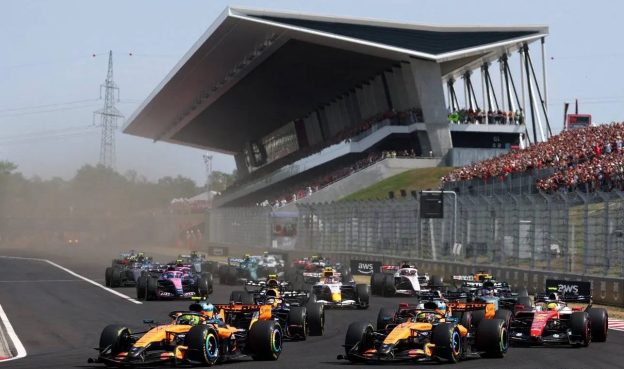
After starting squarely on the back foot under the new Formula 1 rules regime for 2026, McLaren finally came good in the eleventh round of the season in Hungary, as reigning champion Lando Norris out-dueled and out-paced his teammate Oscar Piastri, as well as Red Bull’s Max Verstappen and Mercedes’ Kimi Antonelli, to take his first win of the year in dominant fashion. With mighty Mercedes’ pace advantage neutralized by the short, twisty and slow nature of the Hungaroring, the second slowest circuit on the calendar to Monaco, Norris made good on the exceptional consistency he showed here in earning pole on Saturday over Red Bull, Ferrari and the Silver Arrows, and then had to contend with Piastri, who started from P3 on the grid but passed both the Ferrari of Charles Leclerc and then stablemate Norris in quick order on Lap 1 of the 70-lap contest. It quickly became clear that the fight for the win would be between the two McLaren men, barring the reliability issues that have been the bane of Team Papaya all season long.
A bird’s-eye view of the race start from the helicopter 🚁🎥#F1 #HungarianGP pic.twitter.com/UNlXEJBkL1
— Formula 1 (@F1) July 27, 2026
Piastri kept Norris behind him until pitting on Lap 17 to doff his opening Pirelli Mediums for a set of the Hard tires and attempt to run a long second stint on the more durable rubber. Norris pulled the same swap a lap later and came out still behind Piastri, albeit vocally trying to convince his pit wall that his car was the faster and all this fighting between them was a waste of effort and resources. The McLaren braintrust pulled the plug on the internecine battle in their own way by splitting the strategy for the rest of the race between the two cars, opting to box Piastri a second time on only Lap 33 for another set of Hards, while Norris stayed out, still pleased with the performance of his now 15-lap old Hard tires. This enabled him to build the gap to Piastri, who also came to grief when the inattentive back marker Carlos Sainz failed to follow blue flags in his Williams and closed the racing line on Piastri, leading to contact between the two. That cost Piastri serious time as well potentially damaging his car. Norris kept stretching his advantage, running all the way to Lap 40 before making his second stop. The overcut and yet another fine stop by his McLaren mechanics worked a treat, bringing the English World Champion out ahead of his Australian rival.
Here’s the Sainz/Piastri moment 💥#F1 #HungarianGP pic.twitter.com/IYkdAQYTTi
— Formula 1 (@F1) July 26, 2026
With Piastri unable to challenge from the rear, Norris used the pace advantage of his fresh Pirellis to move back towards the front. He inherited second place when Red Bull’s Max Verstappen made his second stop, choosing an alternate Hard to Soft tire strategy for what was ostensibly his final stint. Norris then set about hunting down Mercedes’ Kimi Antonelli, who was running a very long second stint en route to inheriting the lead due to staying out while others boxed. But Antonelli’s Merc on aging tires was no match for Norris freshly shod McLaren and Norris blew by him to retake the lead on Lap 46 after several laps of hard dicing between the two young aces. Now obviously losing time, Antonelli then decided to make his second stop on Lap 54, which turned out to be the lucky call of the race. Two laps later Piastri came to an abrupt stop on track with a heartbreaking gearbox failure, his second mechanical failure of the season and his fifth non-scoring day in eleven races. With the Virtual Safety Car deployed, Norris made the decision to duck in for Softs to finish out the race, still coming out ahead of the second place Verstappen due to the reduced speed, as well as the remarkably third place Antonelli, who also benefited from solid strategy to overcome a penalty-affected P7 starting spot and vault himself back to the podium. Norris won by a very handy 15 seconds when all was said and done, with a highly vocal yet highly effective Verstappen holding on to P2 by 3.7 seconds over Antonelli.
Bold and brilliant 💪#F1 #HungarianGP @Max33Verstappen pic.twitter.com/ysh5ZjTl9L
— Formula 1 (@F1) July 26, 2026
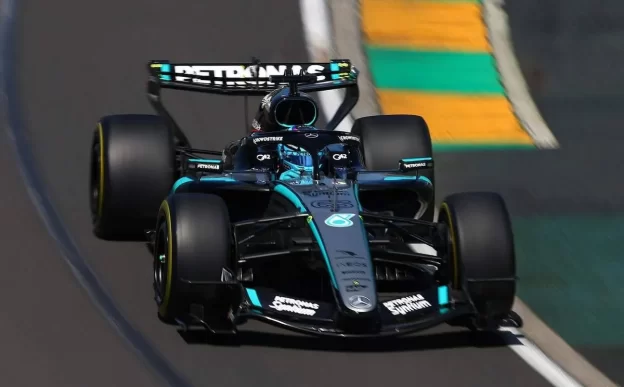
It was a good way to go into the break for the top there and their teams but the same could not be said of Ferrari. Despite the Prancing Horses looking the the team to beat here entering the weekend, and Lewis Hamilton barely missing out on pole to Norris by a scant .008 seconds, the team from Maranello was undone by a penalty to Hamilton for impeding during qualifying that dropped him to P5 on the grid and then a poor start from the dirty side of the track by the now P2 Leclerc. As the Monegasque spun his wheels at the getaway, he was jumped by both Piastri and Verstappen. Hamilton also managed to overtake Leclerc early but found it incredibly difficult to make further headway following that, especially against the stubborn Red Bull of Verstappen, as the two greatest drivers of their generation engaged in a multi-lap mano a mano. And when Hamilton did manage to get ahead of Verstappen on pit strategy by running a short first stint in Softs before switching to the preferred Hards, he was taken by surprise by the Dutchman on Lap 15, when Verstappen, fresh from the pits himself and seemingly coming from a mile back, dive bombed his way past the Ferrari into Turn 1. It was a race full of sound and fury for the Scuderia that wound up signifying not very much, as Hamilton earned a late race pit lane speeding penalty that demoted him to fifth place and Leclerc was therefore promoted to P4, despite rather mediocre long run race pace. The second Red Bull of Isack Hadjar came home a solid P6, while the second Mercedes of George Russell recovered somewhat from a nightmare anti-stall start that saw the Briton drop from seventh to the rear of the field on the opening lap. Russell fought back to his original P7 position but it continued a tough run of form and fortune for the preseason favorite. The long summer break is probably coming at the right time for him.
Top 10 finishers of the Hungarian GP:
| POS | DRIVER | TEAM | RACE TIME | LAPS | PITS | FASTEST LAPS |
|---|---|---|---|---|---|---|
| 1 |
|
McLaren | 1:39:56.180 | 70 | 3 | — |
| 2 |
|
Red Bull | +15.080 | 70 | 2 | — |
| 3 |
|
Mercedes | +18.728 | 70 | 2 | — |
| 4 |
|
Ferrari | +23.840 | 70 | 3 | 1:22.000 (58) |
| 5 |
|
Ferrari | +24.540 | 70 | 3 | — |
| 6 |
|
Red Bull | +55.488 | 70 | 2 | — |
| 7 |
|
Mercedes | +57.503 | 70 | 2 | — |
| 8 |
|
Racing Bulls | +1 Lap | 69 | 2 | — |
| 9 |
|
Audi | +1 Lap | 69 | 2 | — |
| 10 |
|
Racing Bulls | +1 Lap | 69 | 1 | — |


Complete race results available via Formula1.com.
With the enforced summer break upon us, the next race is not until the weekend of August 23rd, when the teams return from vacation and take on the dunes of Zandvoort in the Netherlands. Hope to see you then when the F1 festivities resume and enjoy your summer in the meantime!